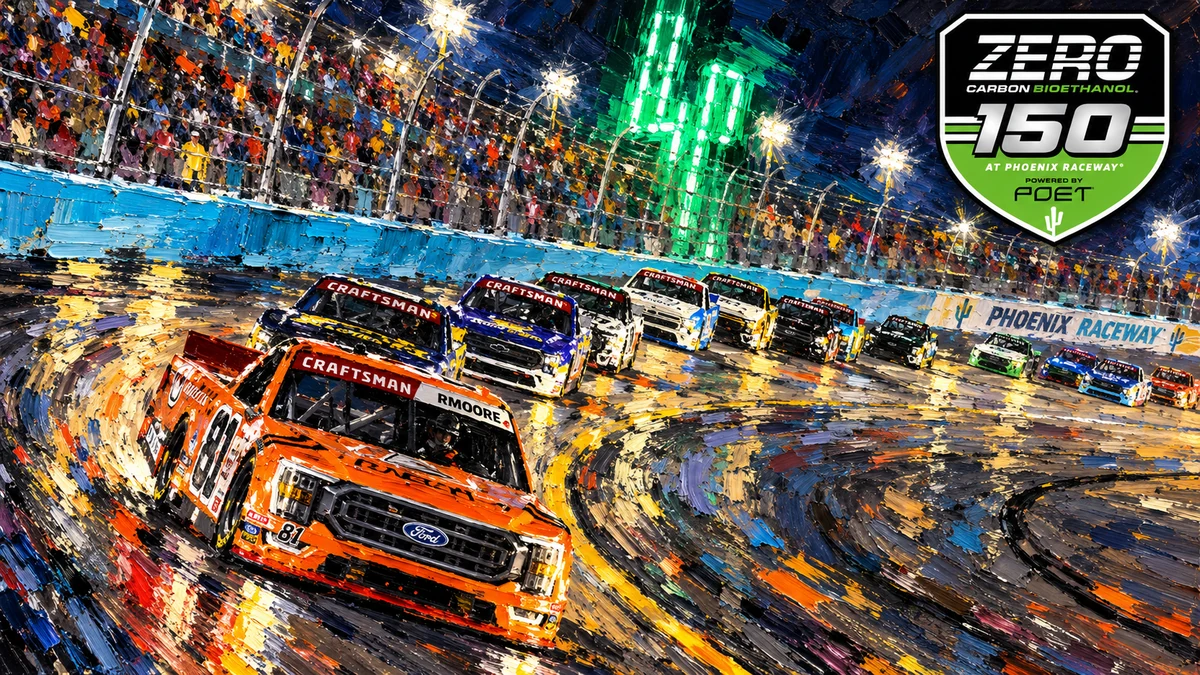
Riggs cut Honeycutt's advantage to 17 points at Charlotte. Their championship fight now moves to Phoenix, alongside a field featuring several developing drivers.
Layne Riggs made the championship fight tighter at Charlotte. Friday's Zero Carbon Bioethanol 150 Powered by POET gives him another chance to press Kaden Honeycutt, whose lead is now 17 points as the Truck Series arrives at Phoenix Raceway. Their duel moves from a fast intermediate oval to a one-mile track, with little room to waste another opportunity.
Riggs' Charlotte victory was his seventh of the season. Honeycutt finished third behind Christian Eckes, preserving the lead but losing part of the cushion he had built. The result sets up a Phoenix weekend in which both speed and execution remain central to the championship story.
The Lesson From Charlotte
The two contenders split the opening stages at Charlotte, then met again in the closing battle. Honeycutt brushed the wall while defending with seven laps remaining, allowing Riggs and Eckes through. Riggs also identified pit-road execution as something his team still needed to improve despite its winning pace.
That combination is the reason to watch more than the running order on Friday. A quick truck can recover from a setback, but every recovery uses time and track position. A clean afternoon offers a different kind of advantage: fewer problems to solve when the final segment begins.
Eckes' runner-up finish keeps him in the conversation beyond the lead pair, while Chandler Smith completed the Charlotte top five. Phoenix will test whether those challengers can put themselves into the decisive part of the race rather than simply follow the championship leaders home.
New Experiences in the Field
Ben Maier will drive Freedom Racing Enterprises' No. 76 Chevrolet in his first Truck Series oval race. The team says he has prepared with simulator work, and Phoenix will be his first start for the organization. He already has experience on the series' road and street courses, including an 11th-place finish at St. Petersburg this year, but Friday presents a different assignment.
Jackson Lee faces a similar transition in Team Reaume's No. 23 Ford. His four previous Truck starts this season came at St. Petersburg, Watkins Glen, Lime Rock Park and San Diego. Phoenix is his first oval start in the series, turning practice into an important opportunity to build familiarity before racing in traffic.
Those learning curves should be treated on their own terms. A driver making this transition must work out how to repeat laps, manage the changing balance and communicate useful adjustments to the crew. The title contenders arrive focused on points; these entries also have a development target that will not be fully captured by a single qualifying position.
A Compact Race With Important Early Points
The field contains 36 trucks for 36 available positions. Practice is scheduled for Friday, October 16, at 3:30 p.m. ET, followed by qualifying at 4:35 p.m. ET. The 150-lap race is scheduled for 7:30 p.m. ET, with television coverage on FS2 and FOX Business.
Stage breaks come at laps 45 and 90, leaving a scheduled 60-lap final segment. That gives the race a compact shape: the opening stages account for most of the distance, and there is limited time afterward to recover from an avoidable mistake.
Goodyear is bringing the same tire codes used on the Truck Series' previous Phoenix visit. This setup has also appeared at four tracks this season, including Richmond and New Hampshire. Teams have three new race sets. Familiar equipment helps establish a reference, but the drivers still have to find the right balance for this track and this weekend.
Practice should reveal which trucks can keep turning without losing their drive off the corner. Qualifying then establishes track position, not the result. For Honeycutt and Riggs, the most useful performance would join those pieces together: early points, controlled pit stops and enough pace left to race for the win.
Fantasy Outlook
Riggs, Honeycutt and Chandler Smith each cost $14. Eckes and Ty Majeski are $13. Selecting two of those drivers leaves between $22 and $24 for the remaining three positions, so the lower half of the roster is a meaningful part of the decision rather than a place to spend whatever remains.
Daniel Hemric is $11, Ben Rhodes $10 and Jake Garcia $9. Maier is $5 and Lee is $3, but their oval transitions deserve attention before either is treated as a straightforward budget solution. Low prices create flexibility elsewhere; they do not remove the uncertainty around an unfamiliar assignment.
Build five drivers within the $50 cap and use the A-through-E multipliers of 2.0, 1.75, 1.5, 1.25 and 1.0 deliberately. Friday's practice and qualifying are still pending, so leave room to reassess the full combination. A headline contender can anchor a roster, but the other four drivers and the order of the multiplier slots still determine how complete that team is.