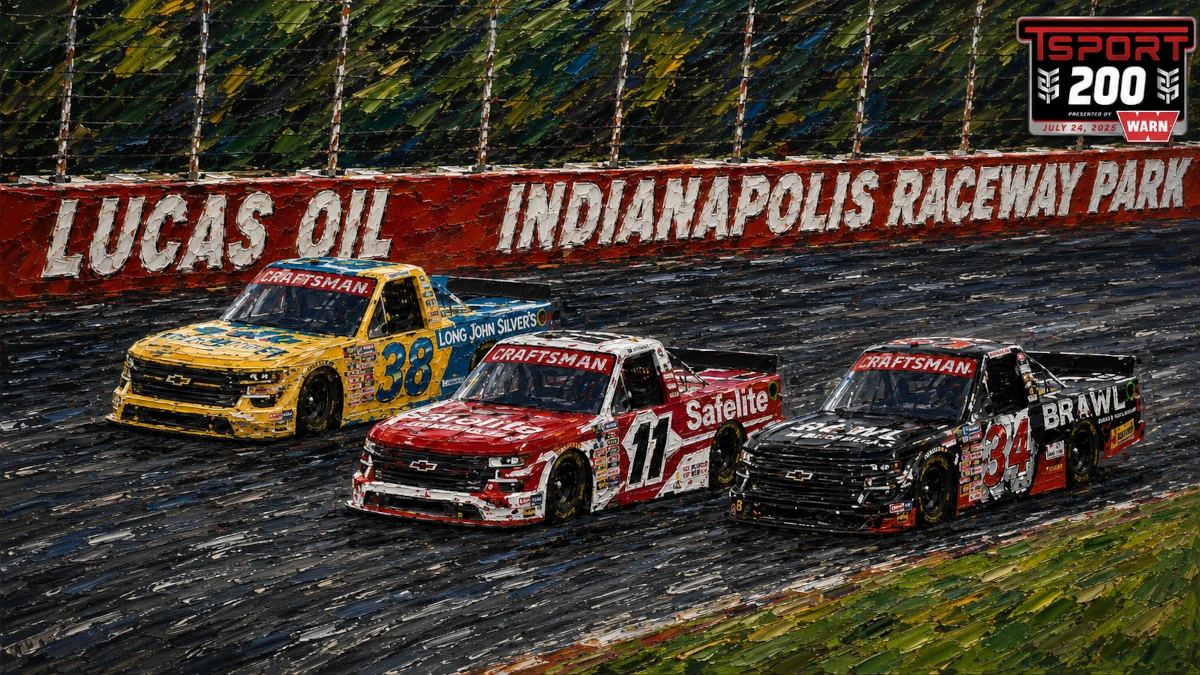
Layne Riggs returns to Lucas Oil Indianapolis Raceway Park as the defending winner and FantasyJolt favorite, but Christian Eckes, Chandler Smith and a 38-truck field make Friday night's 200-lap sprint a difficult slate to solve.
The Indianapolis weekend begins seven miles west of the Brickyard, under the lights and in the kind of traffic that can make a 0.686-mile short track feel even smaller. Lucas Oil Indianapolis Raceway Park does not reward a driver for merely having the fastest truck. It rewards the driver who can use the brake pedal without cooking the rear tires, clear traffic before the leader arrives and keep enough forward drive for the final 40 laps.
That is the assignment for Friday night's TSport 200, where 38 trucks will squeeze into a 200-lap race that has little room for recovery. Layne Riggs arrives as the defending winner, the current betting favorite and the strongest play in the FantasyJolt model. The obvious choice is obvious for a reason. The more important question is how much of the rest of the lineup must be sacrificed to afford him.
The Weekend Setup
The Truck Series gets one concentrated afternoon at IRP. Practice begins at 3 p.m. Eastern, qualifying follows at 4:05 and the green flag is scheduled for 8 p.m. The race breaks at Laps 60 and 120, leaving an 80-lap final stage in which tire conservation, short-track traffic and pit-road execution should finally outweigh raw qualifying speed.
Those sessions will not occur in identical conditions. A truck that looks planted in the afternoon sun may become too tight in the center after the track cools. Crew chiefs need a setup that survives the transition without giving away so much early speed that the leader threatens to put them a lap down. On a track this short, a small handling problem becomes a large track-position problem in a hurry.
The 38-truck entry list adds another layer. Every restart will place slower traffic within reach of the leaders, and the midfield will have to decide whether to use the bumper or spend precious laps waiting for a clean opening. That makes starting position important, but not decisive. A driver who qualifies 18th with a truck that protects the right rear can still become a fantasy asset. A driver who qualifies fifth on one-lap speed can disappear after 30 green-flag laps.
Riggs Returns With the Target
Riggs won this race last summer and comes back with four victories and nine top-10 finishes in the current FantasyJolt season data. The model ranks the No. 34 at P1 and projects 47.6 points, the highest total in the field. At $15, he is expensive without being difficult to understand: he has the track result, the recent production and the equipment to control the race.
The available outright market, around +275, has already priced in most of that argument. Riggs is the rightful favorite, but the number leaves little margin for the sort of restart trouble that can decide an IRP race. He is a stronger FantasyJolt anchor than a must-bet favorite.
Chandler Smith shares the $15 salary, but not the same projection. Smith is ranked P4 with 36.7 projected points. His two wins and nine top 10s establish the ceiling, yet paying the same salary as Riggs requires a reason discovered in practice. If Smith shows the best sustained lap average or wins the pole with clear long-run pace, the leverage is real. Before the trucks unload, Riggs is the cleaner selection.
Eckes Is the Pressure Point
Christian Eckes may determine how this slate is built. His $13 salary sits below the premium tier, but his P2 normalized projection is second only to Riggs. The model expects 35 points, and his average finish of 10.1 is the best current-season mark among the primary Truck regulars near the top of the board.
That combination makes Eckes the balanced-build anchor. A Riggs lineup needs savings. An Eckes lineup can surround him with three or four credible top-15 trucks instead of relying on multiple deep punts.
Nicholas Sanchez is $14 with a P3 projection, while Kaden Honeycutt costs the same and ranks P9. Honeycutt's one win and 10 top 10s provide a stronger season-long floor than the model's finishing position suggests, so he becomes more interesting if qualifying creates place-differential room. Ty Majeski is also $14, but a P6 projected finish and 28.5 points make him a practice-dependent play rather than a foundational one.
The middle tier offers useful stability. Daniel Hemric costs $11 and ranks P5 with 29 projected points. Landen Lewis carries the same salary and point projection at P10. Grant Enfinger at $12 ranks P12, but his experience in long short-track races gives him a path to outperform it if the event becomes an exercise in tire management.
Daly Draws the Spotlight, Queen Brings the Value
Conor Daly's appearance in the No. 25 Ram will receive plenty of attention in Indianapolis. His résumé and local connection make the entry compelling, but FantasyJolt treats it as a value play rather than a headline selection. Daly costs $8 and ranks P16 with 21 projected points. That is playable if practice confirms the truck has top-20 speed. It is not enough to select him merely because the weekend is in Indianapolis.
Brenden Queen is the more attractive cap-saving option. At $7, he ranks P8 and projects 25 points. No other driver at that salary combines the same finishing expectation and scoring floor. Queen can fund Riggs without turning the fifth lineup spot into a pure survival bet.
Toni Breidinger is the high-variance punt at $3. Her normalized projected finish is P17 with 21 points, a profile that can return value at the minimum salary. Jonathan Shafer also deserves attention at $5 with a P20 projected finish and 21 points. Those drivers are not interchangeable with Queen, but each creates a route to two premium trucks if qualifying does not expose a major speed deficit.
FantasyJolt Strategy
Start with the race shape. Eighty laps in the final stage is enough for the best long-run trucks to separate themselves, but cautions can repeatedly reset the field and amplify restart position. A five-driver lineup filled with volatile names can lose most of its ceiling in one stack-up. Favor drivers attached to stable teams and use no more than one true punt before practice.
The preferred balanced core is Eckes at $13, Hemric at $11 and Queen at $7. That trio costs $31 and leaves $19 for two positions, enough to add one solid mid-tier truck and one lower-cost value. The premium route begins with Riggs at $15 and Queen at $7, leaving $28 for the other three spots. That is workable, but it demands discipline.
Qualifying should decide the final version. Riggs starting outside the top 10 would strengthen an already strong projection. Queen or Hemric qualifying deeper than their modeled finish would create place-gain appeal. A value driver who unexpectedly qualifies near the front should be treated with suspicion unless the long-run practice data supports it.
Best Bets
Outright lean: Layne Riggs around +275. He is the defending winner and owns the best FantasyJolt projection. The price is short, so this is a measured play rather than the strongest value on the weekend.
Fantasy anchor: Christian Eckes at $13. Eckes projects second in finishing position while costing less than the five drivers above him. He is the cleanest way to build depth.
Best value: Brenden Queen at $7. A P8 projected finish gives Queen the strongest salary-adjusted case in the lower half of the board.
Contrarian play: Chandler Smith at $15. Riggs should carry more lineup popularity. If Smith matches him on long-run pace Friday afternoon, the equal salary becomes useful leverage.
Key Stats
- 200 laps and 137.2 miles: The short distance makes every lost lap expensive.
- Stage breaks at Laps 60 and 120: The final 80 laps create the longest uninterrupted test.
- 38 entries: Traffic will be a competitive factor from the opening stage.
- 47.6 projected points: Riggs leads the FantasyJolt model.
- P2 projected finish: Eckes owns the best modeled finish outside Riggs.
- $7 for a P8 projection: Queen is the slate's clearest cap-saving play.
IRP usually reveals the winner slowly, one corner exit at a time. The trucks that still turn through the center after 150 laps will control the final stage. The FantasyJolt lineups that respect that long-run test should be in position to do the same.