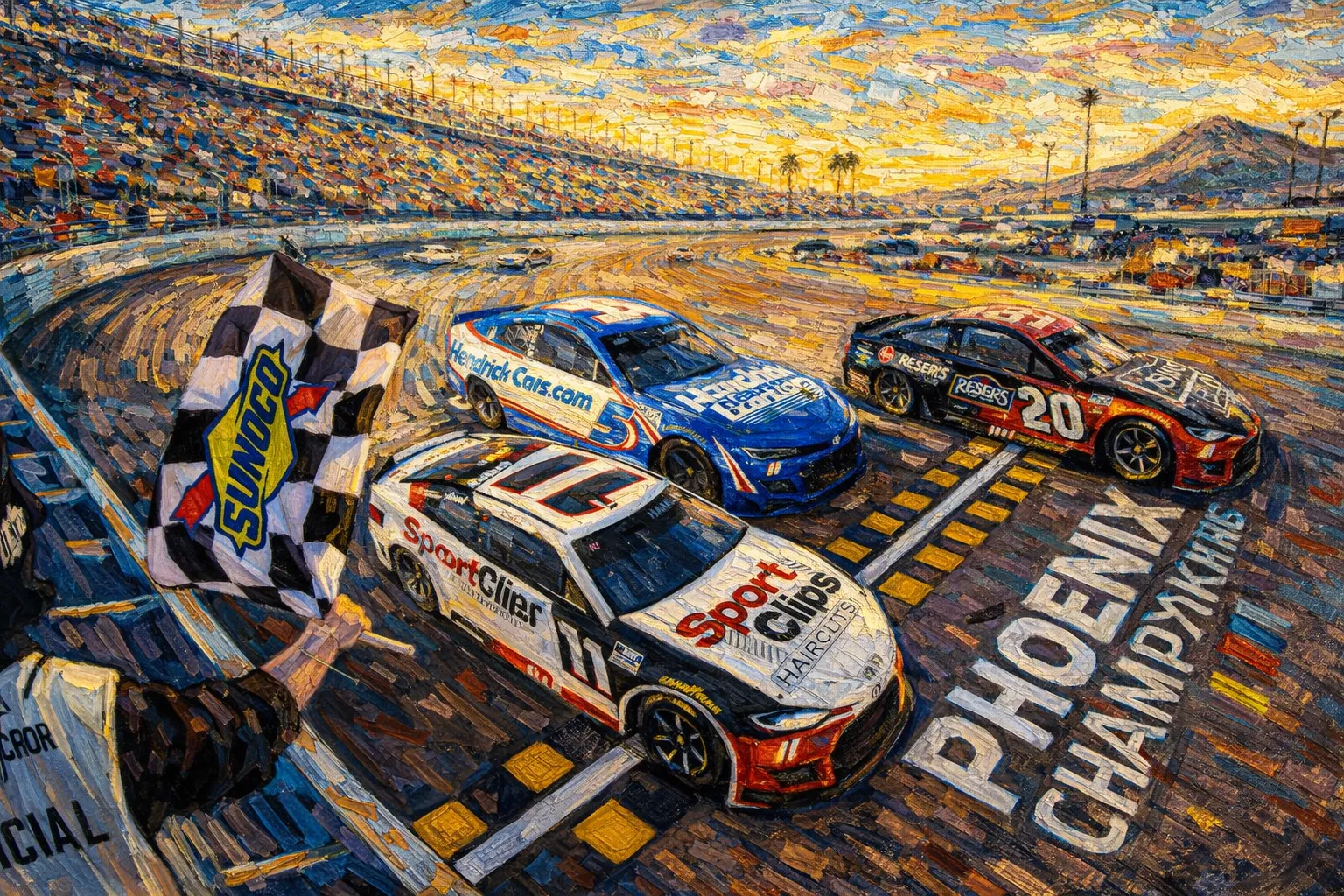
Denny Hamlin leads projections at 44.0 FJ points with 50 laps led at the track he's dominated for a decade. Kyle Larson projects the most laps led (58) but costs a premium. Chase Briscoe in JGR equipment at $12 is the value play of the slate. Plus: Bowman is OUT — Anthony Alfredo subs in the #48.
The Desert Flat Track That Decides Everything
Phoenix Raceway isn't the biggest track on the NASCAR schedule, but it might be the most consequential. This 1-mile flat oval in the Sonoran Desert has hosted the championship finale since 2020, and every driver in the garage knows every inch of it. The Shriners Children's 500 is 312 laps of pure short-track strategy — restarts are violent, clean air is king, and the driver who can navigate lapped traffic through the dogleg will be standing in victory lane.
Last year at Phoenix, Denny Hamlin and Kyle Larson went toe-to-toe in one of the best races of the season. Hamlin led 143 laps. Ryan Blaney's late-race surge earned him a podium. This is a track where the best equipment and the best drivers rise to the top — and with Tyler Reddick riding a historic three-race win streak to open 2026, the entire field is chasing the 23XI Racing Toyota.
Breaking news: Alex Bowman will miss this race after falling ill during the COTA race. Anthony Alfredo will pilot the No. 48 Hendrick Motorsports Chevrolet as a substitute. This is a significant downgrade — Bowman was projected for 21.4 FJ points at a $10 salary. Alfredo is an unknown quantity in Cup-level Hendrick equipment at Phoenix.
Race Details
| Detail | Info |
|---|---|
| Race | Shriners Children's 500 |
| Track | Phoenix Raceway (Avondale, Arizona) |
| Date | Sunday, March 8, 2026 |
| Green Flag | 3:30 PM ET |
| TV / Radio | FOX / MRN / SiriusXM |
| Distance | 312 laps / 312 miles |
| Surface | Asphalt — 1 mile, dogleg oval |
| Banking | 8-9 degrees (turns), 3 degrees (dogleg) |
Track Profile: Why Phoenix Rewards the Elite
Phoenix is a 1-mile flat oval with a distinctive dogleg in the backstretch that creates passing opportunities you won't find at other short tracks. The low banking (8-9 degrees) puts a premium on mechanical grip and pit strategy. Tires wear quickly, and the driver who can manage their right-rear through long green flag runs will have the edge when it counts.
Track notes for fantasy players:
- Laps led are concentrated among 2-4 drivers — this is a dominator's track
- Clean air advantage is massive; qualifying position matters more here than most short tracks
- Stage points follow the same drivers who contend for the win
- Pit strategy can swing 5-10 positions — watch for teams gambling on tire calls
- The dogleg creates unique passing opportunities not found at other 1-mile tracks
Drivers to Watch
The Favorites
Denny Hamlin (#11, $14 FJ / $11,000 DK / $12,500 FD, Joe Gibbs Racing Toyota) — Hamlin is the projection king at Phoenix with 44.0 FJ points, a projected 5.3 finish, and 50 projected laps led. He led 143 laps at Phoenix last year and has been the best flat-track racer in the Cup Series for a decade. At $14 FJ, he's the safest high-floor play in the field — the kind of guy who gives you 35+ points even on a "bad" day. Lock him into Group A and don't overthink it.
Kyle Larson (#5, $15 FJ / $10,500 DK / $13,000 FD, Hendrick Motorsports Chevrolet) — Larson projects at 42.8 FJ points with a 7.1 projected finish and a field-leading 58 projected laps led. His raw speed at Phoenix is unmatched — when the 5 car is right, nobody can touch it for pure pace. The concern is his $15 FJ salary eats more cap than Hamlin ($14) for slightly less projected output. Still, if Larson hits his ceiling, he's the highest-scoring driver on the board.
Ryan Blaney (#12, $15 FJ / $11,200 DK / $14,000 FD, Team Penske Ford) — Blaney projects at 39.4 FJ points with 44 projected laps led. He's the most expensive driver across all three platforms — the reigning champion carries a premium, and Phoenix's flat surface suits his smooth driving style. The value concern is real at $15 FJ, but his dominator upside (laps led + stage wins) gives him a ceiling that justifies the price in cash games.
The Contenders
Chase Elliott (#9, $13 FJ / $9,000 DK / $10,500 FD, Hendrick Motorsports Chevrolet) — Elliott projects at 39.3 FJ points with a 8.7 projected finish and 43 laps led. At $13 FJ, he offers nearly identical projection to Blaney at $2 less — that's the kind of salary savings that unlocks your entire lineup. A strong Group B candidate across all platforms.
Joey Logano (#22, $13 FJ / $9,200 DK / $11,000 FD, Team Penske Ford) — Logano projects at 39.2 FJ points and excels at Phoenix with his aggressive restart style. The Penske equipment is top-notch on flat tracks, and Logano's ability to lead laps (42 projected) makes him a dominator play at a mid-tier price. Another excellent Group B option.
Christopher Bell (#20, $14 FJ / $10,200 DK / $11,500 FD, Joe Gibbs Racing Toyota) — Bell projects at 37.9 FJ points with 39 projected laps led. He's been quietly elite at Phoenix, and the JGR Toyotas have the best short-track package in the garage. At $14 FJ, he's competing with Hamlin for your Group A slot — but if you want to differentiate from the chalk, Bell is the pivot.
The Value Plays
Chase Briscoe (#19, $12 FJ / $9,500 DK / $10,000 FD, Joe Gibbs Racing Toyota) — Briscoe at 37.1 projected FJ points and $12 is one of the best values on the board. He's now in JGR equipment with 31 projected laps led — a dominator-lite profile at a Group C price. His 10.0 projected finish gives him a safe floor, and the JGR short-track package gives him ceiling. This is a smash play.
A.J. Allmendinger (#16, $5 FJ / $5,500 DK / $6,000 FD, Kaulig Racing Chevrolet) — At 28.8 projected FJ points and only $5, Allmendinger is the steal of the slate. A 14.1 projected finish at this salary is absurd value. He won't lead laps, but his consistency on short tracks and his veteran racecraft make him a must-play in Group D or E.
Michael McDowell (#71, $8 FJ / $6,100 DK / $5,200 FD, Spire Motorsports Chevrolet) — McDowell projects at 25.8 FJ points with a 14.9 projected finish. At $8 FJ, he's quietly efficient — the kind of set-and-forget value play that gives you a solid floor while your premium picks provide the ceiling. Perfect Group D candidate.
The Dark Horse
Bubba Wallace (#23, $10 FJ / $7,200 DK / $8,000 FD, 23XI Racing Toyota) — Wallace projects at 30.7 FJ points with a 13.3 projected finish and 27 laps led. The 23XI equipment has been fast all season with Reddick's three wins, and Wallace is priced like a mid-tier option with legitimate top-10 upside. If the 23 car hits its marks, Wallace could be the tournament-winning pivot at $10.
The Bowman Situation
With Bowman out and Anthony Alfredo in the #48, this seat becomes an avoid on all platforms. Alfredo hasn't had significant Cup seat time and is jumping into a car mid-weekend. Hendrick equipment is elite, but there's no track time to dial it in. Fade Alfredo everywhere — but watch for his DK/FD salary to be priced low enough that contrarian tournament players take a flyer.
Fantasy Jolt Strategy
$50 salary cap / 5 drivers / Groups A-E with multipliers
Phoenix is a chalk track — the best drivers dominate, and paying up works. The key decision is which two premium drivers to stack in Groups A and B, then finding value to fill out your roster.
Projected Salary Tiers
| Group | Multiplier | Targets | Why |
|---|---|---|---|
| A (2.0x) | $14-$15 | Denny Hamlin ($14) | 44.0 projected pts, 50 laps led, best value per dollar among elites |
| B (1.75x) | $12-$13 | Chase Elliott ($13) | 39.3 pts at $2 less than Blaney/Larson — the efficiency play |
| C (1.5x) | $10-$12 | Chase Briscoe ($12) | 37.1 pts with JGR equipment at a Group C price |
| D (1.25x) | $5-$9 | A.J. Allmendinger ($5) | 28.8 pts at $5 — the best points-per-dollar on the board |
| E (1.0x) | $3-$5 | Riley Herbst ($3) or Cody Ware ($3) | Minimum salary to afford premium stack |
The Build: Hamlin (A) + Elliott (B) + Briscoe (C) + Allmendinger (D) + Herbst (E) = $47. You have $3 left to upgrade — swap Herbst to Ty Dillon ($4) or Stenhouse ($4) if you want a slightly higher floor.
Alternate Build: Larson (A/$15) + Briscoe (B/$12) + Wallace (C/$10) + Allmendinger (D/$5) + Herbst (E/$3) = $45. More salary flexibility with a differentiated A-slot.
DraftKings Strategy
$50,000 salary cap / 6 drivers / Place differential + laps led scoring
DraftKings rewards laps led (0.25 pts each) plus a 5-point bonus for most laps led, making dominators the key to winning. Phoenix concentrates laps led among 2-3 drivers, so stacking the top is the optimal approach.
Core Plays
| Tier | Targets | Salary | Why |
|---|---|---|---|
| Must-Have | Denny Hamlin | $11,000 | 50 proj laps led, dominator bonus candidate |
| Premium | Kyle Larson | $10,500 | 58 proj laps led — highest in the field |
| Mid-Tier | Chase Briscoe | $9,500 | 31 proj laps led at mid-range salary |
| Mid-Tier | Chris Buescher | $8,500 | 12.9 proj finish, consistent producer |
| Value | Bubba Wallace | $7,200 | 27 proj laps led, upside at discount |
| Min-Price | Cody Ware | $4,800 | Minimum salary opens cap for dominator stack |
The Build: Hamlin ($11K) + Larson ($10.5K) + Briscoe ($9.5K) + Buescher ($8.5K) + Wallace ($7.2K) + Ware ($4.8K) = $51,500. Swap Ware for Riley Herbst ($4,900) or drop Buescher to Keselowski ($8,300) to fit under cap.
DK-Specific Tip: Laps led correlation is massive at Phoenix. Hamlin + Larson is the core dominator stack. If you're building for tournaments, pivot one to Blaney ($11,200) for ownership leverage — Hamlin will be the highest-owned driver on the slate.
FanDuel Strategy
$60,000 salary cap / 5 drivers / 0.1 pts per lap led
FanDuel's flatter scoring means finishing position is the primary point driver. Consistent top-10 finishers outperform boom-bust plays here. The $60K cap gives more flexibility to stack premium drivers.
Core Plays
| Tier | Targets | Salary | Why |
|---|---|---|---|
| Captain | Denny Hamlin | $12,500 | Best projection in the field, safe floor |
| Premium | Chase Elliott | $10,500 | 8.7 proj finish at a fair price |
| Mid-Tier | Chase Briscoe | $10,000 | JGR equipment, 10.0 proj finish |
| Value | Bubba Wallace | $8,000 | 13.3 proj finish with 23XI speed |
| Value | A.J. Allmendinger | $6,000 | 14.1 proj finish at bargain salary |
The Build: Hamlin ($12.5K) + Elliott ($10.5K) + Briscoe ($10K) + Wallace ($8K) + Allmendinger ($6K) = $47,000. Leaves $13K in cap space — upgrade Allmendinger to Buescher ($8.5K) or swap Wallace for Logano ($11K) to go elite-heavy.
FD-Specific Tip: Phoenix's chalk-friendly nature means paying up for safe finishers is the play. Hamlin + Elliott + Briscoe is a JGR/Hendrick core that projects for three top-10 finishes. Fill the last two slots with the best remaining value.
The Bottom Line
Phoenix is a track where the cream rises, and the projections reflect it. Denny Hamlin leads at 44.0 FJ points with the best combination of projected finish (5.3) and laps led (50). Kyle Larson has the highest laps-led projection (58) but carries a premium price. The biggest value on the board is Chase Briscoe — 37.1 projected points at $12 FJ in JGR equipment is a gift.
The Bowman news shakes up the Hendrick stable but doesn't change the strategy. Elliott and Byron remain premium plays, and the #48 with Alfredo becomes a pure fade. A.J. Allmendinger at $5 FJ with 28.8 projected points is the kind of salary relief that lets you stack two elites at the top.
Build for the chalk. Trust the dominators. And don't get cute — at Phoenix, the fast cars win.
Green flag drops at 3:30 PM ET on FOX. Build your lineups now.