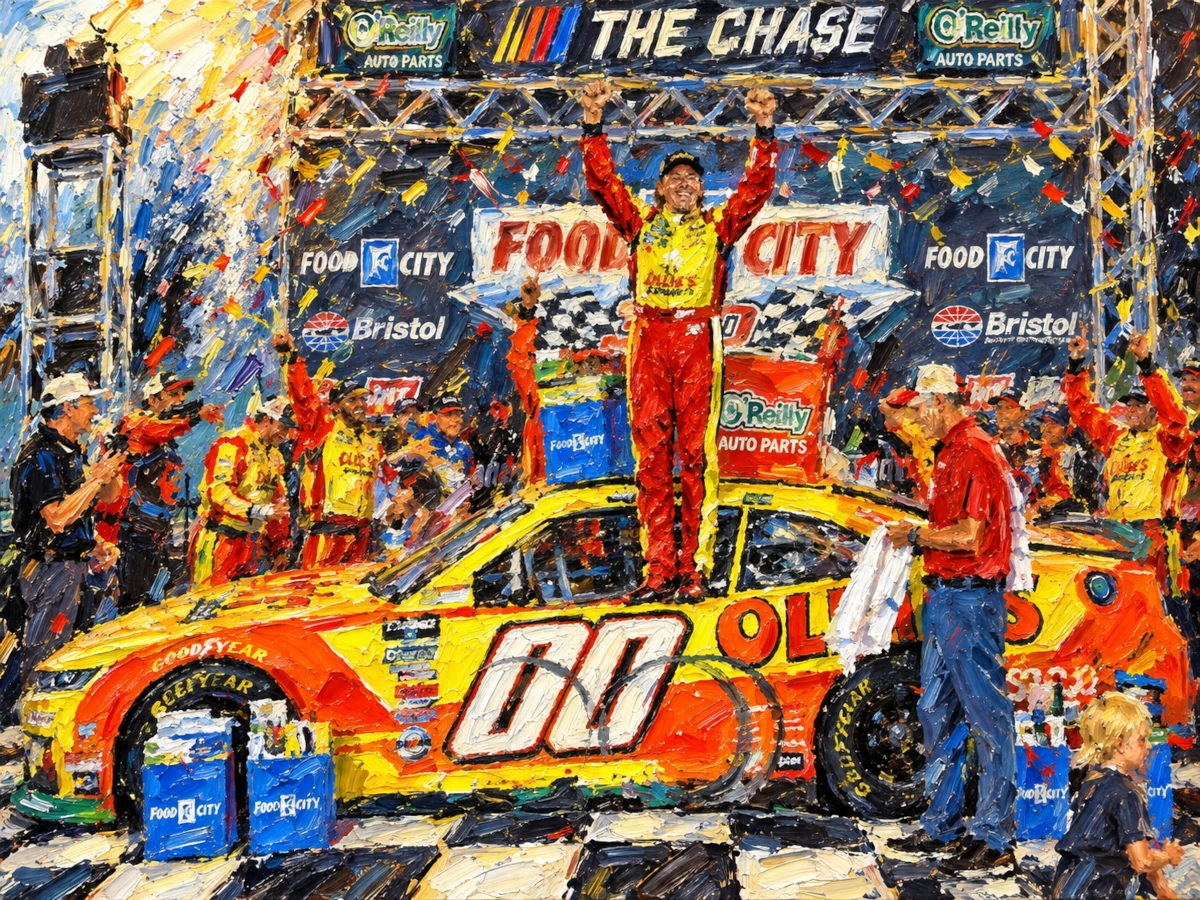
Sheldon Creed beat William Sawalich in overtime, while Justin Allgaier led FantasyJolt scoring and anchored the $50 perfect lineup.
Race Summary
Sheldon Creed found his winning opportunity when the leaders chose track position and his team chose tires. In Friday night's Food City 300 at Bristol Motor Speedway, crew chief Jonathan Toney brought the No. 00 Haas Factory Team Chevrolet to pit road late in the race. Creed worked his way back toward the front, then used the inside lane to take the lead from William Sawalich in overtime. The final margin was 0.253 seconds, and the victory was Creed's third of the season.
The race had offered several different versions of a likely winner. Jesse Love started on the pole after rain canceled qualifying, while Justin Allgaier overcame damage in traffic to win the first stage. Carson Kvapil took control through the middle portion, won Stage 2 and eventually led 156 laps. That advantage disappeared when smoke and a late pit stop interrupted his run. Allgaier inherited the opportunity, but a restart battle with Love sent the No. 7 into the outside wall and changed the contest again.
Taylor Gray then pressured Love, and Sawalich emerged ahead as those two fought for position. Creed was moving forward on newer tires, with the earlier decision to surrender track position now paying off. Ryan Sieg's late crash brought the final caution and sent the race beyond its scheduled 300 laps. Sawalich had the lead for the restart, but Creed accelerated ahead on the bottom. Sawalich countered in the outside lane and stayed close, without finding the run needed to retake first place.
Creed finished the 305-lap race ahead of Sawalich and Brent Crews. Allgaier recovered to fourth, with Corey Day fifth. The result extended Creed's championship lead to 11 points over Allgaier after finishes of first, second and first in the opening three Chase races. It was a sharp contrast with the frustration on pit road: Allgaier confronted Love after the finish, and Love acknowledged that his late decision had damaged both drivers' chances. Inspection subsequently confirmed Creed's victory and the finishing order.
Final Top 10
| Finish | Driver | Start | Laps Led | FJ Base Points |
|---|---|---|---|---|
| 1 | Sheldon Creed | 2 | 3 | 50.3 |
| 2 | William Sawalich | 16 | 13 | 45.3 |
| 3 | Brent Crews | 6 | 0 | 53.0 |
| 4 | Justin Allgaier | 9 | 49 | 62.9 |
| 5 | Corey Day | 26 | 0 | 43.0 |
| 6 | Taylor Gray | 5 | 0 | 47.0 |
| 7 | Sam Mayer | 3 | 0 | 48.0 |
| 8 | Parker Retzlaff | 7 | 0 | 37.0 |
| 9 | Dean Thompson | 12 | 0 | 33.0 |
| 10 | Sammy Smith | 8 | 0 | 37.0 |
Key Takeaways
A Faster Car for the Final Restart
Creed did not need to control the longest green-flag run to win. His stop exchanged immediate position for grip, and the subsequent cautions gave him chances to use it. He credited his crew's tire call and pit work after the race, while acknowledging that the Chevrolet's balance had been a struggle. The winning stint was a late solution to that problem, not evidence that the No. 00 had dominated all evening.
Kvapil's Advantage Did Not Survive
Kvapil's second-place first stage and Stage 2 victory showed how consistently the No. 1 had run near the front. His 156 laps led accounted for more than half the race, yet he finished 24th, four laps down. That reversal explains why the final order alone is an incomplete account of Bristol: a substantial amount of the race's competitive work belonged to a driver who was no longer in the winning battle.
The Inspection Penalty Is Not a Rear-Start Penalty
Corey Day's No. 17 and Taylor Gray's No. 54 each had a loose lug nut after the race. Both teams lose pit-stall selection for Las Vegas. Their Bristol results stand, and that penalty should not be confused with an instruction to start at the back of the next race. Day retains fifth and Gray sixth in the inspected order.
Fantasy Recap
Allgaier produced the strongest FantasyJolt result with 62.9 base points at a $16 salary. Fourth place supplied 39 points, his first- and second-place stage finishes added 19, and 49 laps led contributed another 4.9. That combination beat Creed's 50.3 despite the difference in their finishing positions. At Bristol, the scoring accumulated before the final restart mattered as much as the order at the checkered flag.
Crews ranked second with 53.0 points, followed by Kvapil at 51.6. Kvapil's disappointing finish was softened by 19 stage points and 15.6 points for laps led. Creed's victory brought 45 finish points, five stage points and 0.3 for leading the final three laps. These are FantasyJolt totals, not NASCAR championship points, and they illustrate why selecting the eventual winner alone would not have captured the strongest possible score.
Gray added 47.0 points at $13, including the single fastest-lap bonus. His verified fastest complete green-flag circuit was Lap 7 in 15.851 seconds. Love still returned 47.4 points despite finishing 17th because his two stage finishes and 84 laps led supplied substantial production. Neither driver needs a place-differential bonus to explain that total; this FantasyJolt scoring format does not award one.
The affordable finishers were important to making a five-driver roster fit. Dean Thompson's ninth place returned 33 points for $8, while Brennan Poole scored 28 for the same salary. Logan Bearden supplied 23 at $6. Those options mattered because spending heavily on multiple front-running drivers quickly left little room for the remaining slots. Strong points-per-dollar value did not always mean the lowest available salary, and a balanced finishing result could be more useful than a costly name.
Austin Hill and Rajah Caruth were expensive disappointments, returning 19 and 18 points at salaries of $14 and $12. Anthony Alfredo's $10 entry supplied nine points. Unlike Kvapil or Love, those drivers did not have stage or laps-led production to offset their finishing positions. The distinction is useful when reviewing a roster: a poor finish can hurt in very different ways depending on what a driver banked earlier in the race.
FantasyJolt Perfect Lineup
| Group | Driver | Salary | Base Points | Multiplied Points |
|---|---|---|---|---|
| A | Justin Allgaier | $16 | 62.9 | 125.80 |
| B | Brent Crews | $14 | 53.0 | 92.75 |
| C | Dean Thompson | $8 | 33.0 | 49.50 |
| D | Brennan Poole | $8 | 28.0 | 35.00 |
| E | Carson Ware | $4 | 12.0 | 12.00 |
This hindsight-optimal lineup used the full $50 cap and scored 315.05 points. Allgaier and Crews occupied the two strongest multiplier slots, with Thompson and Poole contributing affordable finishing points. Carson Ware's $4 salary completed the combination. Ware was not a leading scorer on his own; his roster value came from allowing the other four drivers to fit together. This is a retrospective maximum using the actual results, not a lineup claimed to have been recommended before the race.
Looking Ahead
The O'Reilly Auto Parts Series takes a week off before the Focused Health 302 at Las Vegas on October 3, scheduled for 7:30 p.m. ET. Six Chase races remain. Creed carries the lead, while Allgaier leaves Bristol with a strong points result but another missed winning opportunity. Kvapil remains third in the championship, 37 points behind Creed, after a race that showed both his speed and the cost of not converting it into a finish.
By the Numbers
- 305 laps: Five beyond the scheduled distance.
- 0.253 seconds: Creed's winning margin.
- 156 laps led: Kvapil's race-high total.
- Three laps led: Creed's winning contribution at the front.
- 62.9 points: Allgaier's leading FantasyJolt base score.
- 315.05 points: The highest-scoring legal $50 FantasyJolt lineup.