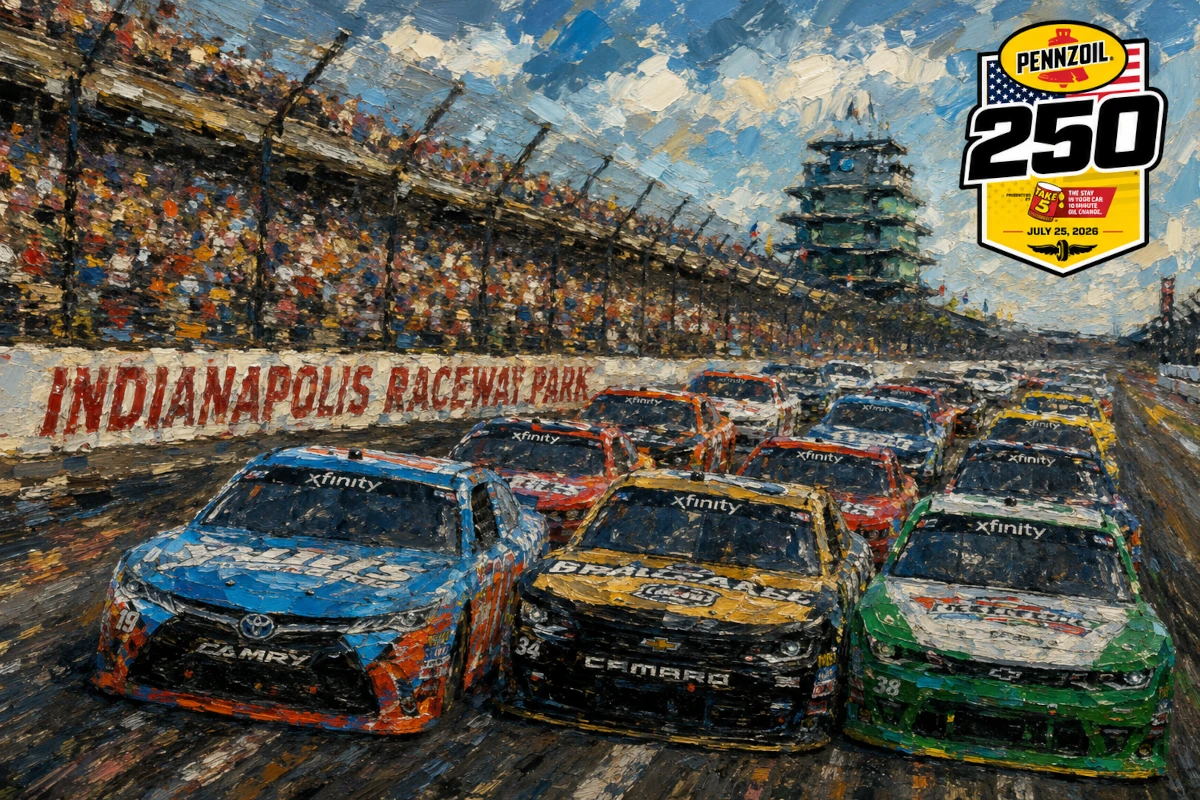
Chase Elliott and Ross Chastain join the O'Reilly Series regulars at Indianapolis, where Justin Allgaier is the betting favorite but FantasyJolt's model sees a very different pecking order for Saturday's Pennzoil 250.
Indianapolis has a way of making a supporting race feel like a career test. The frontstretch is too long to hide a weak engine, the corners are too flat to forgive a missed entry and the yard of bricks has turned ordinary Saturday victories into permanent résumé lines. This year's Pennzoil 250 adds another complication: the O'Reilly Auto Parts Series regulars must handle all of that while Chase Elliott and Ross Chastain occupy two of JR Motorsports' strongest cars.
The Cup visitors do not make the outcome automatic. They make every mistake more expensive. Justin Allgaier enters as the market favorite, Jesse Love and Carson Kvapil continue to build their own cases, and a 38-car field will spend 100 laps fighting for the same narrow strip of clean air.
The Weekend Setup
The Pennzoil 250 covers 100 laps and 250 miles on the 2.5-mile Indianapolis oval. Stage breaks arrive at Laps 30 and 60, leaving a 40-lap final run that sits near the edge of a fuel window. A caution, an aggressive short fill or one slow stop can turn a straightforward race into a calculation that changes every lap.
The series practices Friday at noon Eastern, then qualifies around midday Saturday before the 4 p.m. green flag. That schedule gives teams a full night to interpret practice, but the race surface will be warmer and less forgiving. The driver who can hold the car low through the four nearly identical 90-degree corners will carry speed onto the long straightaways. The driver who misses the center will be vulnerable for half a lap.
Passing at Indianapolis is not impossible, but it is rarely cheap. Aero wake can dull the front tires just when a trailing driver needs the car to turn. Restarts and pit sequencing become the cleanest opportunities to gain several positions at once. Fantasy lineups should value drivers whose teams consistently execute those transitions.
Elliott Changes the Board
FantasyJolt's model is unusually decisive about Elliott. At $15, the No. 88 ranks P1 and projects 44.7 points. Elliott is offered around +475 in the current outright market, a price that creates a rare alignment between a Cup driver's equipment, model advantage and usable betting value.
The limited O'Reilly Series sample is the obvious caution. Elliott does not race these cars every week, and a 100-lap event leaves less time to learn what the car needs in traffic. But the No. 88 team knows how to win this race, and Elliott's methodical approach fits a track that punishes overdriving. He is the preferred premium fantasy play and the most interesting outright number among the favorites.
Chastain costs $14 and ranks P2 with 33 projected points. His market price sits near +850, reflecting both his Cup experience and the uncertainty of a part-time start. He is more attractive as a lineup pivot than as the first betting choice. If Elliott draws overwhelming roster popularity, Chastain offers comparable organizational strength at one dollar less.
Allgaier Owns the Market, Not the Model
Allgaier is priced around +300 to win, making him the betting favorite. His Indianapolis experience, six victories and 16 top-10 finishes in the current season data explain the confidence. FantasyJolt is far more cautious. The model ranks him P11 with 27.9 projected points, well below Elliott and behind several cheaper choices.
That disagreement is the central handicapping decision of the race. Allgaier has earned favorite status through form and team strength, but +300 asks bettors to accept a short price in a race with two Cup teammates and several emerging contenders. In FantasyJolt, his $15 salary creates the same problem. There is no discount for choosing the established series leader.
Brent Crews and Sam Mayer cost $14 and trade around +600 and +750, respectively. Their P12 and P13 rankings do not support the market enthusiasm before practice. Jesse Love is the more compelling alternative. He costs $13, ranks P5 with 32.1 projected points and is available around +1200. Love does not need to be treated as the likely winner to be useful; the double-digit price and salary discount compensate for the risk.
Carson Kvapil also costs $13, ranks P4 and brings 30.9 projected points. His outright price near +1300 puts him in the same value neighborhood. Kvapil's appeal is less about a single dominant number and more about a profile with few obvious weaknesses.
Rajah Caruth Is the Salary Puzzle
The strongest point-per-dollar projection belongs to Rajah Caruth. At $9, he ranks P3 and projects 33.2 points. That modeled total trails only Elliott among the entire field. Caruth's price creates the flexibility to use a premium anchor without dropping into the minimum-salary tier, and his projected finish gives him standalone value even in a balanced lineup.
Parker Retzlaff is another useful middle play at $10. He ranks P10 with 29.2 projected points, narrowly ahead of several drivers priced above him. Brandon Jones costs $11 and ranks P6 with 29.1 points. Sammy Smith, also $11, offers 30.4 points with a P8 projected finish. The density of this tier argues against using multiple deep punts.
Dean Thompson at $8 is the safer lower-cost option, ranking P7 with 25 projected points. Jeremy Clements also costs $8 and ranks P16 with 23 points. Among the true punts, Blake Lothian is $3 with a P31 projected finish and 16 points. That can complete a stars-and-scrubs build, but the opportunity cost is significant when Caruth is only six dollars more and projects more than twice the score.
FantasyJolt Strategy
The cleanest construction starts with Elliott at $15 and Caruth at $9. That leaves $26 for three drivers and preserves several combinations in the $8 to $10 range. Add Retzlaff at $10 and Thompson at $8, and the final $8 can be used on Clements or Jeb Burton. It is a balanced lineup despite paying the maximum salary for Elliott.
The contrarian route fades Elliott and builds around Chastain, Love and Kvapil. That trio costs $40, so it requires two minimum-range drivers and carries considerable downside. A more practical Elliott fade begins with Love or Kvapil, then uses Jones, Smith, Retzlaff and Caruth to collect five drivers ranked inside the projected top 10.
Starting position matters at Indianapolis because long green runs can stretch the field. Caruth qualifying inside the top 10 would reduce some place-differential appeal but confirm speed. Allgaier qualifying poorly would create a path for the model to be wrong in a productive way. Elliott qualifying on the first two rows would strengthen the case that the No. 88 can control the race from clean air.
Best Bets
Chase Elliott to win around +475: The FantasyJolt model ranks Elliott P1, and the price is longer than Allgaier despite Elliott's decisive modeled edge.
Jesse Love to win around +1200: Love offers a salary discount, a competitive 32.1-point projection and a double-digit number in a race where pit execution can create an upset.
Best fantasy value: Rajah Caruth at $9. A P3 projected finish and 33.2 points make Caruth the pivotal salary play.
Market fade: Justin Allgaier around +300. Allgaier can absolutely win, but the favorite's price and $15 salary do not account for his P11 model ranking.
Key Stats
- 100 laps and 250 miles: There is limited time to recover from a poor stop or early handling problem.
- Stage breaks at Laps 30 and 60: The 40-lap final stage creates fuel and tire strategy options.
- 38 entries: Saturday qualifying will matter throughout the field.
- P1 projected finish: Elliott owns the strongest model position of the Indianapolis weekend.
- 33.2 projected points at $9: Caruth is the best salary-adjusted play.
- Six wins and 16 top 10s: Allgaier's season explains why the market remains confident.
Indianapolis will tempt teams to chase track position at every opportunity. The winner will be the driver who gets it without giving away the balance needed for the final 40 laps. Elliott arrives with the strongest forecast, but the series regulars have 250 miles to make the Brickyard their own.