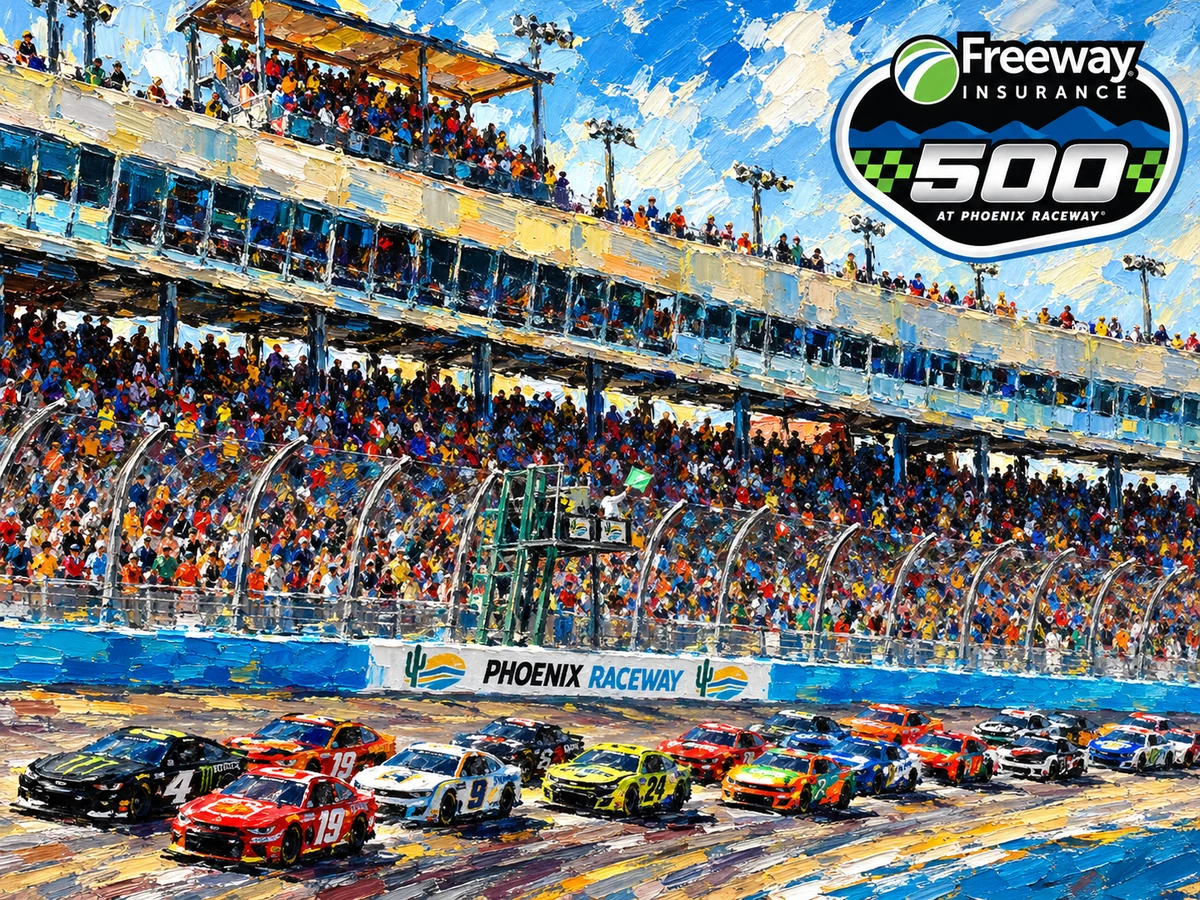
Larson brings a 49-point lead to the desert, Briscoe arrives with consecutive victories, and Blaney returns looking for a third straight Phoenix win.
Kyle Larson has the championship lead, Chase Briscoe has the winning streak, and Ryan Blaney has the recent Phoenix record. Sunday's Freeway Insurance 500 puts those strengths on the same one-mile oval with four races remaining in the Cup Series season. The desert is no longer the final stop, but it can still change the direction of the title fight.
Larson arrives 49 points ahead of Denny Hamlin, with Christopher Bell 51 behind and Briscoe 65 back. The challenge for the pursuers is not simply to beat the No. 5 on Sunday. They need to take enough points away to change the outlook for the remaining races.
A Lead Built on Complete Afternoons
Charlotte illustrated why Larson has been difficult to catch. He finished sixth, yet still added nine points to his advantage over Hamlin. NASCAR's post-Charlotte assessment highlighted how the leader has avoided the damaging days that have interrupted his challengers' campaigns. Even an afternoon without a trophy has kept him moving forward.
Briscoe supplies the counterargument. Consecutive wins at Las Vegas and Charlotte have moved him into the conversation, although Phoenix asks different things of a car than those two intermediate ovals. His first Cup win came here in 2022. The question this weekend is whether his current momentum can carry across that change in track character.
The title race continues beyond Arizona through Talladega and Martinsville before the finale at Homestead-Miami. That sequence makes Sunday a chance to bank points before the uncertainty of a superspeedway, not a championship-deciding race in isolation. Under the cumulative Chase format, a strong finish matters alongside the battle for the win.
Blaney and the Phoenix Specialists
Blaney won the last two Cup races at Phoenix, including this year's spring visit. VSiN's race advance notes nine top-five finishes in his last 10 starts here. That consistency makes the No. 12 a central part of the weekend even though he trails Larson in the championship.
The historical case is not his alone. NASCAR's statistical advance lists Larson as the active leader in average Phoenix finish at 10.042 across 24 starts. Hamlin leads active drivers with 18 top-five finishes, while Joey Logano leads the active group in laps led at the track. Those records describe sustained competitiveness, not a promise that any one driver will control this race.
The entry list contains 37 cars, including Corey Heim in the No. 67 for 23XI Racing. With fewer entries than available starting positions, the emphasis in qualifying is on track position rather than a battle simply to make the field.
What the Weekend Must Reveal
Goodyear is bringing familiar tire codes. Cup teams last used this left-side tire at Phoenix in March, while the right-side tire appeared at New Hampshire in August. The weekend allocation includes eight new race sets. Teams therefore have a known starting point, but still need to establish how their cars respond to the conditions they encounter now.
Watch whether a driver can turn through the corner without sacrificing the drive off it. A car that needs extra steering input in the center may also make its driver wait to accelerate. Over a run, that compromise can matter more than an isolated quick lap. Qualifying will answer one question; maintaining balance in traffic will answer another.
Practice is scheduled for Saturday, October 17, at 4:30 p.m. ET, with qualifying at 5:35 p.m. ET. Sunday's 312-lap race is scheduled for 3 p.m. ET on USA. Stage breaks are at laps 60 and 185. Practice and the starting order remain pending.
Fantasy Outlook
Blaney is the highest-priced Phoenix option at $15. Bell, Hamlin and Logano each cost $14, while Larson and Briscoe are $13. Those prices make the first decision a budget choice: paying for one leading contender leaves substantially more flexibility than trying to stack the entire front of the championship picture.
Keselowski and Buescher are $9, with Preece at $8. They offer different ways to complete a five-driver roster, but a lower price should invite closer review rather than an automatic selection. Compare practice consistency, the official starting order and each driver's ability to maintain position through a run before finalizing the team.
FantasyJolt uses a $50 cap and A-through-E multipliers of 2.0, 1.75, 1.5, 1.25 and 1.0. Put the strongest expected contributors in the larger multiplier slots, then check the complete roster rather than evaluating each price alone. Pending practice and qualifying can change the assessment. Track history provides context, not certainty, and a reservation still needs five saved drivers to become a complete team.