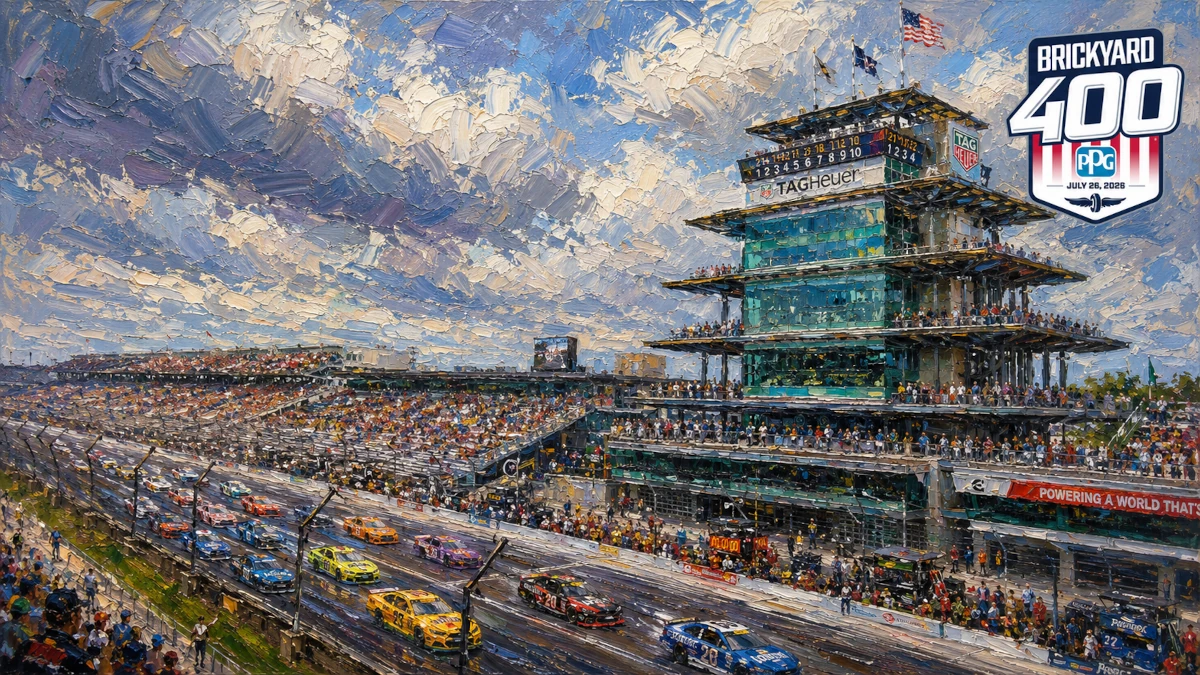
Ryan Blaney meets Todd Gilliland in the In-Season Challenge final while chasing one of NASCAR's biggest trophies. A new right-side tire and 39-car field add uncertainty to Sunday's Brickyard 400.
Ryan Blaney will start Sunday's Brickyard 400 with two prizes available and no practical way to separate them. Winning at Indianapolis would place his name on one of the sport's shortest, most distinguished lists. Finishing ahead of Todd Gilliland would deliver the $1 million In-Season Challenge. The fastest way to settle both is to kiss the bricks.
That double pursuit gives the 22nd points race of the Cup season a clean headline, but the race beneath it is more complicated. Bubba Wallace returns as the defending winner. Denny Hamlin enters as the betting favorite. Goodyear has brought a new right-side tire developed after a June test. Thirty-nine cars must navigate 160 laps on a track where clean air can turn a very good car into an untouchable one.
The Brickyard does not need artificial drama. It creates pressure simply by making every mistake visible for half a mile.
The Weekend Setup
The Brickyard 400 covers 160 laps and 400 miles around Indianapolis Motor Speedway's 2.5-mile oval. The long straightaways reward horsepower and corner exit, but the four flat turns require a driver to slow the car, rotate it at precisely the right point and return to the throttle without washing toward the wall.
Sunday's green flag is scheduled for 2 p.m. Eastern. Teams receive 14 tire sets for the weekend: three for practice, one qualifying set that transfers to the race and 10 new sets for Sunday. The left-side tire has appeared at Chicagoland and other intermediate tracks. The new right side is the variable, developed after a June test involving Ross Chastain, Ryan Preece and John Hunter Nemechek.
The intended result is a tire that better matches the loads created by Indianapolis. The strategic consequence will not be clear until the Cup cars run in traffic. If lap-time falloff increases, crew chiefs gain opportunities to trade track position for fresh tires. If the tire remains consistent over a fuel run, clean air and pit-road execution become even more important.
Thirty-nine entries mean traffic will arrive quickly for the leaders. Corey Heim joins the field in the No. 67 for 23XI Racing, while Casey Mears makes another Cup start in the No. 62 after entering the weekend with 496 career appearances. Those stories broaden the field, but qualifying speed remains essential. Drivers starting deep may spend the opening stage using their tires simply to reach the top 20.
Blaney's Two-Race Sunday
Blaney entered the In-Season Challenge as the No. 3 seed. Gilliland began at No. 25. Four head-to-head rounds later, they meet for the million-dollar prize at a track where both have produced unexpectedly similar results. Blaney's average finish in the two Next Gen oval races at Indianapolis is 5.0. Gilliland's is 6.0.
The route to the final tells a different story. Blaney finished no worse than 11th in the four challenge races and recently won at EchoPark. Gilliland arrives after an eighth-place run at North Wilkesboro, only his second top 10 of the season. The FantasyJolt model reflects that larger body of work: Blaney costs $14, ranks P1 and leads the field with 36.7 points. Gilliland costs $6, ranks P17 and projects 24 points.
At roughly +1200 to win, Blaney is the most appealing outright bet among the primary contenders. Hamlin is shorter at +350, while Kyle Larson sits near +650 and Tyler Reddick around +800. Blaney does not need the trophy to beat Gilliland, but his combination of Indianapolis results, current form and model strength suggests he can chase more than the side prize.
Gilliland is still important for fantasy. His $6 salary and top-20 projection make him a useful cap-saving piece. The challenge final should not alter how the two race each other unless they are together late. Both teams know the best head-to-head strategy is to run the strongest possible 400 miles.
Hamlin Leads a Complicated Favorite Tier
Hamlin's +350 price and $15 FantasyJolt salary identify him as the driver to beat. He owns five wins and 16 top-10 finishes in the current data, and the model ranks him P2 with 32.4 projected points. Indianapolis remains a conspicuous omission from his Cup résumé, which will dominate the pre-race conversation. It does not make him a value bet at a short price.
Larson also costs $15, but ranks P7 with 28.9 projected points. Reddick rounds out the $15 tier at P15 with 27.5 points. Their ceilings are much higher than those projections, yet salary construction asks for production rather than possibility. Blaney offers more modeled points for one dollar less.
Christopher Bell is the other credible premium alternative. At $14, he ranks P4 with 32.1 projected points while trading around +900. Chase Briscoe carries the same salary and a +1200 market price, but ranks P10 with 28.6 points. Bell is the stronger model play; Briscoe is the Indianapolis-area storyline with enough speed to become a practice-driven pivot.
Defending winner Wallace may be overlooked between those groups. He costs $13, ranks P5 and projects 30.7 points. The model does not expect a repeat, but the salary does not require one. Wallace has current evidence that his team understands how to control this race, and he offers a viable alternative to the more popular Blaney-Bell tier.
Preece and Gibbs Create the Value
The most interesting fantasy numbers appear below the favorites. Ty Gibbs costs $12 and ranks P9, but his 32.6 points rank second in the entire field behind Blaney. Carson Hocevar shares the salary and holds a better P6 projected finish, although his point total is lower at 28.5.
Ryan Preece is the slate's clearest value. At $8, he ranks P11 and projects 30.2 points. His participation in the June tire test gives him direct experience with the new setup, though test knowledge should not be confused with a guaranteed speed advantage. Even without that angle, the projection is strong enough to make Preece a core lineup option.
Shane van Gisbergen costs $9 and projects 29.8 points despite a P16 finish ranking. That gap signals upside beyond the finishing-position estimate and makes him a useful tournament play. Chris Buescher at $11 is steadier, ranking P8 with 29.3 projected points.
Gilliland at $6 provides the lower-tier floor. A.J. Allmendinger costs $5 and ranks P28 with 24 projected points, while Michael McDowell is $6 with a P23 projection and 23 points. Those values allow a lineup to roster Blaney and another contender without using a minimum-salary car.
FantasyJolt Strategy
Blaney at $14 and Preece at $8 form the preferred starting point. Add Gibbs at $12, and the lineup has three of the four highest projected point totals for $34. The remaining $16 can be divided between Gilliland and a $10 driver such as Austin Cindric or Brad Keselowski, or between two $8 options.
The Wallace pivot is more balanced. Wallace at $13, Hocevar at $12, Buescher at $11, Preece at $8 and Gilliland at $6 use the full $50 cap without a driver ranked worse than P17. That construction gives up some winning ceiling but protects against the failure of one expensive favorite.
Qualifying will reshape the lower tier. A top driver starting outside the top 20 gains obvious place-differential potential. Preece qualifying near the front could raise his ownership while reducing his path to position gains, although the tire-test experience and projected points would keep him playable.
Best Bets
Ryan Blaney to win around +1200: Blaney combines the model's highest point projection, a 5.0 average finish in the two Next Gen oval races at Indianapolis and recent winning form.
Christopher Bell to win around +900: Bell offers a better price than Hamlin and a stronger FantasyJolt projection than Larson or Reddick.
Best fantasy value: Ryan Preece at $8. His 30.2 projected points nearly match the favorite tier at almost half the salary.
Defending-winner pivot: Bubba Wallace at $13. Wallace can return lineup value without repeating his 2025 victory, and his team owns the most relevant recent success.
Challenge lean: Ryan Blaney over Todd Gilliland. Gilliland's Indianapolis average demands respect, but Blaney's current form and P1 model ranking provide the stronger 400-mile case.
Key Stats
- 160 laps and 400 miles: The race is long enough for pit strategy to cycle several times.
- 39 entries: Traffic and qualifying position will influence the first stage.
- 14 tire sets: A new right-side compound introduces the weekend's largest technical unknown.
- 5.0 average finish: Blaney has been consistently strong in the two Next Gen oval races at Indianapolis.
- 36.7 projected points: Blaney leads the FantasyJolt model.
- 30.2 projected points at $8: Preece supplies the slate's most important value.
- $1 million: Blaney and Gilliland race for the In-Season Challenge prize within the Brickyard 400.
Indianapolis often turns on one restart, one pit stop or one corner exit that appears routine until it is not. Blaney enters with two goals and the strongest model profile. Hamlin brings the favorite's burden. Wallace brings the trophy back. The new tire brings uncertainty. By Sunday afternoon, the bricks will make all of those arguments answer to the same stopwatch.